
Evidence-Based Practices for Teaching Excellence
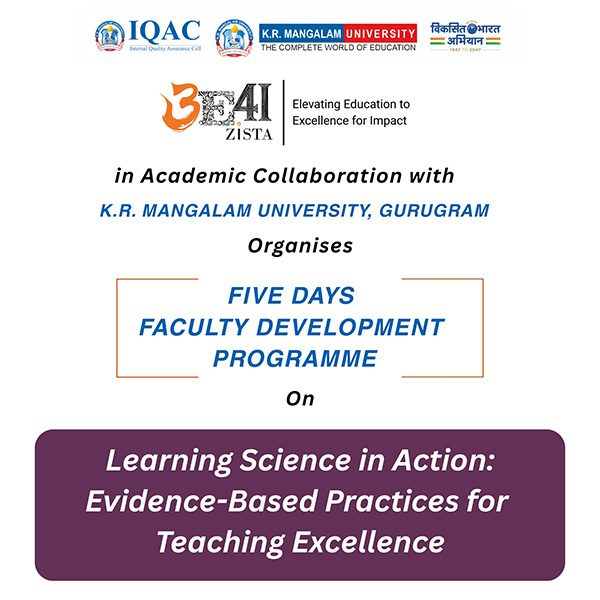
A 5-Day Faculty Development Programme structured as follows:
Designed to strengthen teaching practice through research-informed strategies, reflective engagement, and classroom application.
Collaboration: Delivered in academic collaboration with Zista 3E4I and K.R. Mangalam University.
Programme Focus: Participants will engage with evidence-based teaching practices, the Science of Learning, assessment and feedback strategies, and reflective teaching approaches.
Outcomes: By the end of the programme, participants will be able to apply evidence-based strategies in classrooms, design effective assessments, and refine their teaching practice.
Button will open a new link to payment gateway
Venue:
Multipurpose Hall, A-Block, K.R. Mangalam University
Programme Schedule & Batches
| Batch 1: | 1st to 5th June 2026 |
| Batch 2: | 8th to 12th June 2026 |
| Batch 3: | 11th to 16th June 2026 |
Daily Schedule:
| Activity | Time |
|---|---|
| Registration & Settling In | 09:30 AM – 10:00 AM |
| Session 1 | 10:00 AM – 11:15 AM |
| Break | 11:15 AM – 11:30 AM |
| Session 2 | 11:30 AM – 12:30 PM |
| Lunch Break | 12:30 PM – 01:30 PM |
| Session 3 | 01:30 PM – 02:45 PM |
| Break | 02:45 PM – 03:00 PM |
| Session 4 | 03:00 PM – 04:00 PM |
DAY 1 | Foundations of Effective Learning
Session 1: Science of Learning: How Students Learn
- Exploration of cognitive science principles underpinning the learning process
- Critical differentiation between effective and ineffective teaching practices, grounded in empirical research
- Understanding the roles of memory architecture, knowledge retention, and cognitive load in instructional design
- Implications of the Forgetting Curve and spacing effect for classroom pedagogy
Session 2: Applying Learning Science in Classrooms
- Translating cognitive science theory into practical, implementable classroom strategies
- Systematic identification of inefficiencies and misalignments in current teaching approaches
- Collaborative redesign of classroom methodologies using evidence-based frameworks
- Techniques such as interleaving, retrieval practice, and elaborative interrogation
Session 3: Making Thinking Visible
- Introduction to Visible Thinking Routines (Project Zero, Harvard Graduate School of Education)
- Real-time monitoring and assessment of student understanding through structured protocols
- Strategies for surfacing students’ prior knowledge, misconceptions, and reasoning processes
- Practical workshop: implementing visible thinking strategies in subject-specific contexts
Session 4: Recap, Group Reflection & Q&A
DAY 2 | Assessment & Instructional Design
Session 1: Designing Effective Assessments
- Comprehensive overview of assessment typologies: formative, diagnostic, summative, and ipsative
- Principles of constructive alignment — ensuring coherence between learning outcomes, instruction, and assessment
- Designing assessments that promote deep learning rather than surface-level recall
- Addressing issues of validity, reliability, and fairness in assessment design
Session 2: Rubric Design & Evaluation
- Conceptual foundations of analytical and single-point rubrics
- Defining, operationalising, and communicating quality expectations to students
- Using rubrics as formative feedback instruments and self-assessment tools for learners
- Calibration exercises to ensure inter-rater reliability among faculty assessors
Session 3: Applied Workshop — Assessment Design
- Structured, hands-on creation of contextually relevant assessments and evaluative rubrics
- Collaborative peer review sessions with structured feedback protocols
- Iterative refinement of assessment instruments based on peer critique and faculty input
- Gallery walk presentation of participant-designed assessment artefacts
Session 4: Peer Review & Consolidation Workshop
DAY 3 | Teaching Excellence & Classroom Practice
Session 1: Effective Questioning Techniques
- Theoretical grounding in Socratic dialogue and inquiry-based pedagogical models
- Taxonomy of questioning (Bloom’s, Webb’s Depth of Knowledge) and their classroom applications
- Strategies to drive deeper, sustained student thinking and productive cognitive struggle
- Live practice: facilitated questioning sessions with reflective debriefs
Session 2: Expertise Modelling & Feedback
- Understanding the cognitive underpinnings of expert-novice differences in disciplinary thinking
- Techniques for demonstrating expert reasoning processes: think-alouds, worked examples, modelling cycles
- Frameworks for providing actionable, specific, and growth-oriented feedback to students
- Distinguishing feedback from evaluation; building a culture of iterative improvement
Session 3: Lesson Planning for Impact
- Principles of backward design in structuring high-impact teaching sessions
- Aligning learning objectives, instructional strategies, and assessment mechanisms
- Micro-teaching exercise: faculty design and present lesson segments for peer critique
- Peer review using structured observation protocols; collaborative lesson refinement
Session 4: Lesson Design Showcase & Peer Feedback
DAY 4 | AI & Workflow Management
in Higher Education
Session 1: Introduction to Artificial Intelligence in Academia
- Conceptual foundations of Artificial Intelligence: what AI is, and what it is not
- Overview of Claude by Anthropic: capabilities, responsible use, and academic applications
- Practical use-cases for AI in higher education: lesson preparation, feedback generation, research assistance
- Ethical considerations: academic integrity, bias, attribution, and responsible AI citizenship
Session 2: Prompt Engineering & Workflow Automation
- Foundations of effective prompt engineering: specificity, context-setting, and iterative refinement
- Hands-on Claude workshop: crafting prompts for lesson planning, rubric generation, and feedback drafting
- Task automation strategies to reclaim time and enhance instructional preparation quality
- Integrating AI tools sustainably and ethically into daily academic workflows
Session 3: Q&A, Peer Discussion & AI Tool Reflection
- Facilitated peer dialogue on AI tools explored and lessons learned
- Discussion of institutional policies, copyright considerations, and responsible AI adoption
- Participatory assessment and evaluation exercises using AI-enhanced approaches
- Closing reflection: opportunities and responsibilities of AI in the contemporary classroom
DAY 5 | Classroom Management,
Inclusion & Valedictory
Session 1: Inclusive Classroom & Differentiated Instruction
- Principles of Universal Design for Learning (UDL) and its classroom implications
- Identifying diverse learner profiles and designing differentiated instructional experiences
- Strategies for addressing learning disabilities, language barriers, and socio-economic diversity
- Building equitable assessment practices that uphold academic rigour while ensuring fairness
Session 2: Student Well-being & Positive Classroom Climate
- Understanding the neuroscience of stress, safety, and its profound impact on learning readiness
- Evidence-based strategies for establishing psychologically safe and inclusive classroom environments
- Proactive approaches to student engagement, motivation, and emotional regulation
- Faculty role in supporting student mental health and academic resilience
Session 3: Participant Presentation of Assessments
Each participant presents a learning artefact — a redesigned lesson plan, assessment, or teaching strategy developed during the FDP — to the cohort for peer review and celebration of learning.
Session 4: Feedback, Recognition & Valedictory Ceremony
Programme-wide feedback collection | Certificate distribution | Closing address by senior KRMU leadership | Vote of thanks